At many cancer centers, nutrition support looks like one dietitian covering hundreds of patients. You may get fifteen minutes with them, followed by a photocopied handout and no follow-up, and that is the good version. Plenty of centers have no dietitian on staff at all, and many survivors go through months of treatment without a single conversation about what to eat.
As a (now) virtual dietitian for cancer, I spent over a decade inside that system before I left it in 2019, and I left because I kept seeing motivated people who cared deeply about their health being handed the hardest diagnosis of their life and given nothing usable for the part they could actually control: their diet.
So, here’s everything you need to know about working with a virtual cancer dietician and how it can help you get stronger during and after treatment.
If you want a starting point today, download The Clean Scan Plan! It is my free 10-page guide that helps you get unstuck from the fear and confusion around food and work toward clean scans, naturally.
What Is a Virtual Dietitian for Cancer?
A virtual cancer dietitian is a registered dietitian who specializes in oncology nutrition and works with you one-on-one over video and messaging, so you can reach me directly instead of waiting days for a callback that may never come.
Since you are seeing your dietitian virtually, you can do it from the comfort of your home and keep your appointments even on the days when you are wiped out and do not want to go anywhere. You can also get answers to your questions faster instead of holding them until your next appointment.
The oncology specialization is essential! Any dietitian can tell you to eat more vegetables. An oncology dietitian can tell you how to eat to hold onto your muscle through chemo, get enough protein and steady carbohydrates to lift cancer brain fog, and work with a changed sense of taste so the food is enjoyable.
Your virtual cancer dietitian also knows what your labs are telling you about your nutrition and how to move them in the right direction with nutrient-dense, cancer-fighting foods.
Working on your nutrition during and after cancer treatment gives you back some control. You cannot choose your diagnosis, but you can choose what goes on your plate, and that choice affects how strong you feel and how well you recover.
Learn more about healthy eating with cancer.
5 Reasons You Need a Virtual Cancer Dietitian
I have coached more than 1,000 survivors one-on-one, across every stage and nearly every cancer type, including rare diagnoses. Here is what my clients consistently tell me they were missing.
1. You Get a Cancer Specialist, Not a Generalist
Cancer nutrition is a specialty, and many locations don’t have a specialist practicing it. You can find a dietitian, and that dietitian will give you sound general advice that assumes a body that is not being treated for cancer.
During cancer treatment and recovery, your body is repairing tissue on an enormous scale, holding the line on immune function, and absorbing the impact of drugs that kill fast-dividing cells.
All of that takes a toll on your body, and food is how cancer patients fuel themselves through it. Getting that fueling right takes guidance from someone who understands what your treatment is doing to your body and how nutrition fits into it.
2. You Get Facts, Not Fads
When you search for information on what to eat during treatment and cancer foods to avoid (spoiler alert: there’s no such thing), you get a long list of forbidden foods, an expensive supplement protocol, and a growing certainty that the oatmeal you ate this morning was a mistake.
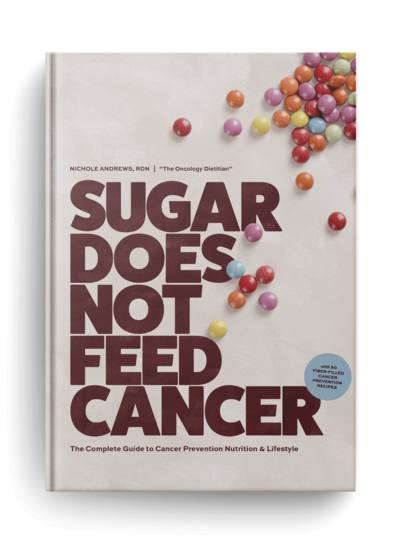
For example, a common myth I often have to bust in my practice is that sugar feeds cancer. I actually wrote a #1 bestselling book titled Sugar Does Not Feed Cancer because the myth is so persistent. In reality, cancer cells use glucose, and so do your brain, your heart, your muscles, and every healthy cell keeping you alive.
In other words, cutting sugar starves you, not your tumor. Carbohydrates are not the enemy, and I cannot count the survivors who have come to me convinced that eating them is dangerous while they are struggling through treatment on 900 calories a day.
As a virtual cancer dietitian, I help you cut through the noise and learn that only two things have strong, consistent evidence linking them to cancer risk: processed meat and alcohol.
When you ask me a question about something that scared you, I can show you the research and explain what it means for you, so you’re getting science-backed facts and not opinions.
3. Nutrition Helps You Tolerate Treatment
Cancer treatment is hard on your body, but nutrition can keep you standing through it.
Between 15% and 25% of people with cancer have already lost their appetite by the time they are diagnosed, before a single dose of chemo, and treatment can take it down further. When you stop eating enough, you lose muscle, and muscle loss is tied to how well you tolerate chemo and how quickly you recover between cycles.
Good nutrition during treatment is linked to better treatment tolerance, fewer interruptions, and milder side effects. When nothing tastes right, your virtual dietitian for cancer can also help you adjust and create meals that are enjoyable, satisfying, and nutritious.
Learn more about how much protein you need.
4. Nutrition Rebuilds You After Treatment
Cancer treatment ending is an amazing milestone, but your body may still not feel like yours. It’s common for cancer survivors to deal with lingering fatigue, brain fog, GI issues, and the general feeling that their strength is not where it was.
All of these are clear signs that you’re depleted, and depletion responds to food.
Around 80% of my clients notice clearer thinking and more reliable day-to-day function by the one-year mark after treatment ends, and 95% who need to regain weight do it with whole food rather than supplements or extremes.
Recovery is not something you have to wait out, but something for you to eat your way through.
Learn more about anti-inflammatory foods and cancer.
5. What You Eat Supports Long-Term Health
Very little about cancer is in your control, but your plate is.
I’m not talking about some miracle diet. You can improve your long-term health and reduce your risk of recurrence through consistently eating enough protein, plants, and variety, plus eliminating the two things with strong evidence behind them: processed meat and alcohol.
After cancer treatment, you’re building a body that serves you for the next thirty, forty, or fifty years, and food is one of the best ways to feel stronger and better. My clients routinely see better A1C, better liver enzymes, better kidney markers, and normalized calcium and vitamin D.
What Diet Is Best for Fighting Cancer?
None of them.
There is no cancer diet. Keto, fasting, juicing, alkaline, cutting sugar, cutting fruit, cutting carbs: every one of them works by subtraction. They take food away from you at the exact moment your body needs the most fuel it has ever needed.
Instead, you need to flip the whole thing around. The goal is adding, not taking away. Add color across the week. Add protein to every meal. Add enough calories that your body has something to build with.
Overall, add the foods you love back into your life (yes, even dessert), because eating well during and after cancer should not come with fear, and it should not feel like a punishment.
Meet Nichole Andrews, RDN, The Oncology Dietitian™
I am a registered dietitian with 15+ years in oncology nutrition, and I have coached more than 1,000 survivors one-on-one across every stage and cancer type.
I wrote the #1 bestselling Sugar Does Not Feed Cancer, and I give you facts, not fads, because health does not come from a handout.
Here is how we can work together:
- VIP 1:1 Cancer Nutrition Coaching gives you personalized nutrition and mindset coaching with high-touch support from your virtual cancer dietitian
- The NED Method™ Membership is an 8-week program inside our membership for lasting energy and peace with food
- The Cancer Healing Vault™ is a self-paced program for survivors during and after treatment that gives you legit, science-backed resources to know what to eat without spiraling about every bite
- The Cancer Prevention Bundle™ is a focused masterclass plus four eBooks on processed meat, alcohol, supplements, and everyday items, so you have the evidence on what raises cancer risk (and what does not) to come back to anytime
- Pediatric Cancer Nutrition Coaching supports parents feeding a child through cancer and helps them nourish with confidence
If you want somewhere to start today, download The Clean Scan Plan. It’s my free, one-of-a-kind nutrition & lifestyle guide that breaks down the 5-pillar approach I use with clients to reduce recurrence risk and rebuild peace of mind.
→ Download The Clean Scan Plan and stop guessing about what to eat!